
Answers to Ma 162 Spring 2005 final
| > | with(linalg): |
Q.1.
| > | eq1:=x+y+z=100000; ## Total Investment |
| > |
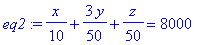
| > | eq2:=(10*x+6*y+2*z)/100=8000; ##Income |
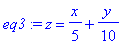
| > | eq3:=z=20*x/100+10*y/100; ##Extra condition |
| > | M:=matrix(3,4,[1,1,1,100000,1/10,3/50,1/50,8000,1/5,1/10,-1,0]);##Augmented matrix |
![M := matrix([[1, 1, 1, 100000], [1/10, 3/50, 1/50, 8000], [1/5, 1/10, -1, 0]])](images/solved_sp05ex44.gif)
| > | A:=matrix(3,4,[1,1,1,100,5,3,1,400,2,1,-10,0]); ##This is same as above, except the variables are scaled to 1000's of dollars and equations simplified. |
![A := matrix([[1, 1, 1, 100], [5, 3, 1, 400], [2, 1, -10, 0]])](images/solved_sp05ex45.gif)
| > | A1:=addrow(A,1,2,-5); |
![A1 := matrix([[1, 1, 1, 100], [0, -2, -4, -100], [2, 1, -10, 0]])](images/solved_sp05ex46.gif)
| > | A2:=addrow(A1,1,3,-2); |
![A2 := matrix([[1, 1, 1, 100], [0, -2, -4, -100], [0, -1, -12, -200]])](images/solved_sp05ex47.gif)
| > | A3:=addrow(A2,2,3,-1/2); |
![A3 := matrix([[1, 1, 1, 100], [0, -2, -4, -100], [0, 0, -10, -150]])](images/solved_sp05ex48.gif)
Now solve by backsub. if we let maple to the work, then:
| > | gaussjord(A); |
![matrix([[1, 0, 0, 65], [0, 1, 0, 20], [0, 0, 1, 15]])](images/solved_sp05ex49.gif)
| > | x=65,y=20,z=15; ##Final answer read off. |
| > |

Q.2
Let x,y be resp. the number of days of operation of the two mines saddle and Horseshoe.
| > | ## Cost calculations C:=14*x+16*y ;## Cost in thousand dollars! |

| > | ## Gold target ineq1:=50*x+75*y>=650; |

| > | ##Silver target ineq2:=3*x+y>=18; ##Target in 1000 ounces |

| > | ##Natural constraints x>=0,y>=0; |

The set up is to minimize C as above subject to the listed inequalities.
Q.3.
| > | ## The region has four corners P,Q,R,S where P:=[0,0];Q:=[4,0];S:=[0,6]; |
![P := [0, 0]](images/solved_sp05ex415.gif)
![Q := [4, 0]](images/solved_sp05ex416.gif)
![S := [0, 6]](images/solved_sp05ex417.gif)
| > | sol:=solve({x+y=6,2*x+y=8},{x,y}); |

| > | R:=subs(sol,[x,y]); |
![R := [2, 4]](images/solved_sp05ex419.gif)
| > | chval:=(p,f)->subs([x=p[1],y=p[2]],f); |
![chval := (p, f) -> subs([x = p[1], y = p[2]],f)](images/solved_sp05ex420.gif)
| > | ["P"=P,chval(P,2*x+6*y)];["Q"=Q,chval(Q,2*x+6*y)];["R"=R,chval(R,2*x+6*y)];["S"=S,chval(S,2*x+6*y)]; |




So the max. is at S =[0,6]
Q.4.
| > | ans[a]:=(110-39)/110; ## remove non drinkers, you have the union of the coffee and tea drinker sets. |
![ans[a] := 71/110](images/solved_sp05ex425.gif)
| > | ans[b]:=(52+41-71)/110; ## find intersection by usual formula. The numerator is 22 |
![ans[b] := 1/5](images/solved_sp05ex426.gif)
| > | ans[c]:=(52-22)/110; ## coffee drinkers minus both coffee and tea drinkers. |
![ans[c] := 3/11](images/solved_sp05ex427.gif)
| > | ans[d]:=[52/110*41/110,22/110]; |
![ans[d] := [533/3025, 1/5]](images/solved_sp05ex428.gif)
| > | evalf(%); |
![[.1761983471, .2000000000]](images/solved_sp05ex429.gif)
The probabilty of the intersection and the product of two probabilities are within 0.5 so in a crude sense they are independent. If the required agreement is stricter, then they are not!
Q.5.
| > | with(combinat): |
| > | ans[a]:=numbcomb(120,7);## Sample space size. Choices of 7 tapes from 120 form the sample space. |
![ans[a] := 59487568920](images/solved_sp05ex430.gif)
| > | ans[b]:=numbcomb(15,2)*numbcomb(105,5)/numbcomb(120,7);evalf(%); |
![ans[b] := 509747/2990828](images/solved_sp05ex431.gif)

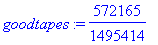
| > | ## First find the prob. of no defective tapes and subtract from 1. goodtapes:=numbcomb(105,7)/numbcomb(120,7); ans[c]:=evalf(1-goodtapes); |
![ans[c] := .6173868909](images/solved_sp05ex434.gif)
| > | ans[d]:=evalf(goodtapes); |
![ans[d] := .3826131091](images/solved_sp05ex435.gif)
Q.6. Sample space is the set of 400 seniors.
| > | maleprob:=evalf(150/400);femaleprob:=evalf(250/400); |


| > | ## Path: female and with D.L. ans[a]:=femaleprob*0.70; |
![ans[a] := .4375000000](images/solved_sp05ex438.gif)
| > | ## Path male and with D.L. ans[b]:=maleprob*0.50; |
![ans[b] := .1875000000](images/solved_sp05ex439.gif)
| > | ## Paths ending with D.L. -> the above two paths added. ans[c]:=ans[a]+ans[b]; |
![ans[c] := .6250000000](images/solved_sp05ex440.gif)
| > | ## The population with no D.L. has two paths: femaleprob*0.30+maleprob*0.5; |

| > | ## out of these, one path has all the females. femaleprob*0.30; |

| > | ## So the probability is: ans[d]:=(maleprob*0.50)/(femaleprob*0.30+maleprob*0.5); |
![ans[d] := .5000000000](images/solved_sp05ex443.gif)
| > |
| > |
| > |