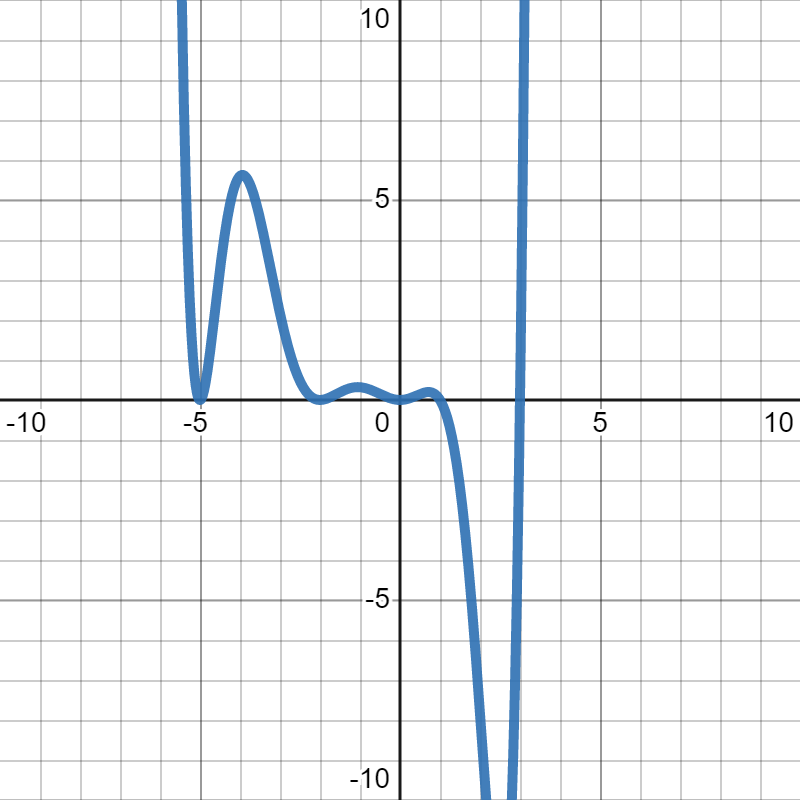
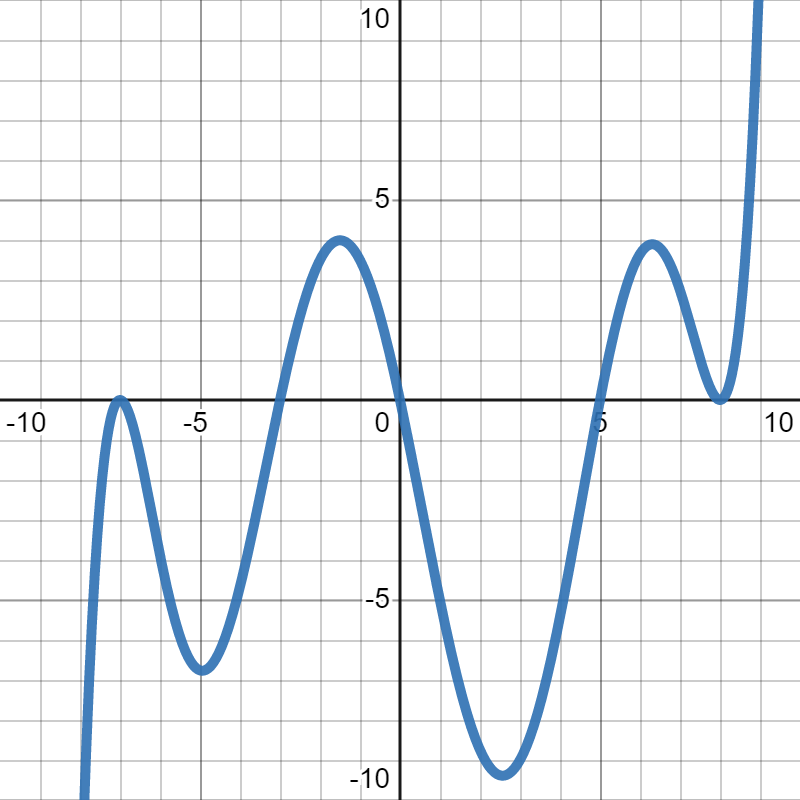
Suppose
\(f(x)=-3x^4(x+5)^3(x-2)^7(x+8)^2\text{,}\) and we want to find its roots. As we always do with roots and
\(x\)-intercept, we begin by setting
\(y=0\text{,}\) so we need to solve the following equation:
\begin{equation*}
0=-3x^4(x+5)^3(x-2)^7(x+8)^2
\end{equation*}
Take a close look at the equation: we have a bunch of things multiplied together and it all equals 0. The fact that it equals 0 is special. There is no way to mulitply things together to get 0, unless one of the numbers you multiplied was already 0.
Why does that matter? Because we know one of the things we multiplied had to be 0 to begin with, this lets us separate our first equation into five separate equations:
\begin{align*}
0\amp=-3\\
0\amp=x^4\\
0\amp=(x+5)^3\\
0\amp=(x-2)^7\\
0\amp=(x+8)^2
\end{align*}
The first equation doesn’t have any
\(x\) in it, and is nonsense since 3 does not equal 0. So that one doesn’t help us, we’ll ignore it. For the other four, we take roots and then add or subtract to solve. Since any root of 0 is still 0, we have four roots:
\(x=0, -5, 2\text{,}\) and
\(-8\text{.}\)